Eight Brussels gems feature among the awardees of the European TASTE programme, which supports solutions that make tourism and food systems more sustainable, more digital and more resilient. In a first phase, these eight SMEs joined the acceleration programme “Go Green, Get Digital, Be Resilient”, each receiving €15,000 and tailored support from the hospitality cluster of hub.brussels to test and refine their innovations. Whether product‑ or service‑based, these projects share the same ambition: to show that Brussels can be both a leading tourist destination and a driving force in sustainable gastronomy.
In a second phase, companies had the opportunity to further develop their project to access additional funding. This step aimed to strengthen the most promising initiatives by making them even more innovative while integrating new partners across Europe, giving them a truly collaborative and transnational dimension. The five Brussels SMEs that applied were all selected, an exceptional achievement that illustrates the maturity of the local ecosystem and the quality of the proposed projects. Thanks to this additional support, their initiatives can now extend beyond Belgium’s borders and actively contribute to transforming food tourism at the European scale.
Discover the five Belgian projects that were awarded:
Brussels Sustainable Food Tour: fermentation as a guiding thread
Among the Brussels projects selected within the European TASTE programme, the one led by Cookwork quickly stood out. Cookwork first developed in Brussels an immersive tourist route centred on fermentation, in collaboration with Concept Chocolate, Fermenthings, La Source Brewery, Parckfarm and Bazaar Trottoir. Their Brussels Sustainable Food Tour offered a full day of discoveries combining workshops, tastings and exploration of lesser‑known neighbourhoods, showing how chocolate, bread, vegetables and beer share the same age‑old process. This pilot demonstrated that a coherent culinary narrative can highlight local artisans, diversify tourist flows and reveal an often‑overlooked industrial heritage.
For the second phase of TASTE, Cookwork designed Fermentastic Paris, a strengthened and transnational version of the concept, developed with Les Camionneuses and four artisans from the 18th arrondissement. The project deepens the fermentation theme (cheeses, lacto‑fermented vegetables, kombucha, sourdough bread) and anchors itself in a neighbourhood undergoing major transformation, revealing workshops rarely accessible to the public. This evolution, more educational, more sustainable, more locally rooted and above all cross‑border, convinced TASTE to support the continuation of the project.
From Farm to Festival Plate: bridging chefs and local producers
The three companies Cross Over Innovation, Man Natura and IMPACTE developed, during the first phase, a simple yet ambitious tool: a methodology enabling effective links between Brussels Food Festival stands and local agroecological producers. Tested at full scale during the 2026 edition, their From Farm to Festival Plate model aims to create short, profitable and low‑carbon supply chains while offering new market opportunities for agricultural SMEs. The objective is twofold: to professionalise the matchmaking between chefs and producers, and to demonstrate that a festival can become a concrete lever for food transition.
For the second phase, the project was propelled to the European level thanks to a major evolution: the integration of transnational partners and innovative tools. With Le Collectif des Festivals(France), the team strengthens its approach through proven sustainability charters and governance tools. With Telegrafo/EcoLoop (Italy), it introduces a digital environmental scoring system based on LCA indicators, allowing the real impact of festival dishes to be measured. This scaling‑up, more digital, more structured, more collaborative, convinced TASTE to grant additional funding. The project thus becomes a reproducible European framework capable of transforming festivals into measurable actors of the food transition, while establishing solid cooperation between Belgium, France and Italy.
Let Eat Stew: celebrating stew and slow meat
The non‑profit ENTIER, a collective of committed restaurateurs, places meat back at the centre of a fairer and more respectful narrative. With Let Eat Stew, it imagined a winter event celebrating stew, slow cooking and the art of valuing the whole animal. Workshops, butchery demonstrations and encounters between chefs, farmers and butchers invite Brussels residents and visitors to rediscover forgotten techniques and a food philosophy that rejects standardisation. In the heart of January, this festival becomes a living plea for ethical, local and deeply human gastronomy.
This dynamic quickly crossed Belgian borders. Throughout the TASTE workshops, ENTIER built connections with Spanish and Italian chefs and artisans, giving rise to a genuine European nose‑to‑tail community. Two major transnational workshops, one in Italy during a Slow Food festival, the other in Belgium, will soon bring together farmers, butchers and cooks to share techniques, stories and responsibilities around the animal. Co‑designed and co‑facilitated, these moments of shared learning recreate a common language between professions and strengthen professional networks that will outlive the project. It is this ability to restore meaning, transmit knowledge and build lasting cooperation between countries that earned ENTIER the additional TASTE funding.
Make your FoodPrint visual: food production goes digital
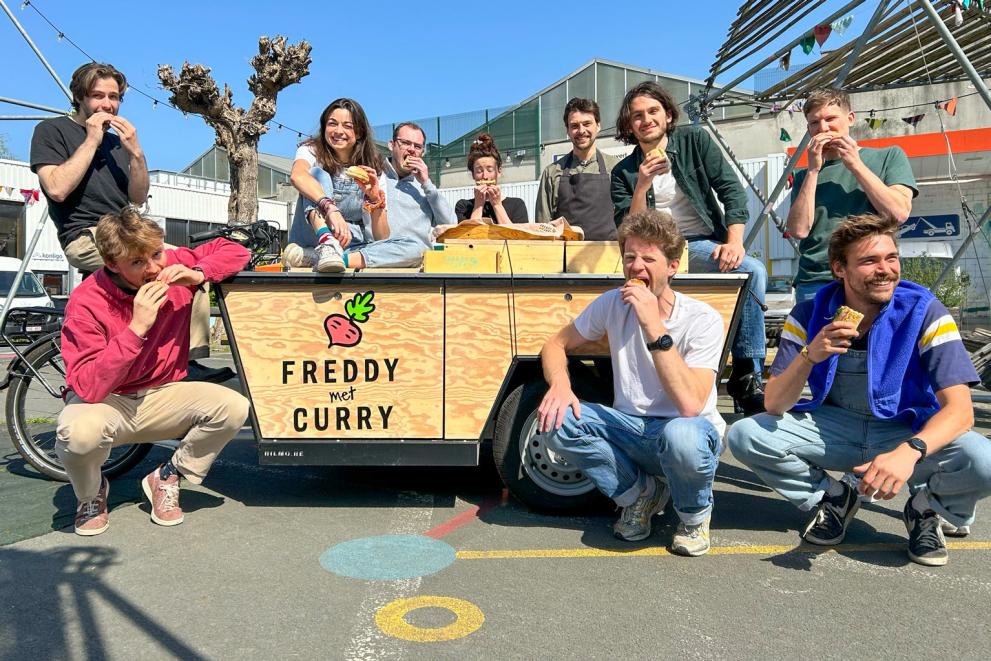
Precisely measuring the environmental footprint of food production is a crucial and technical challenge, one that Freddy Met Curry, a committed and responsible Brussels event caterer, set out to tackle. After testing several tools, the company developed a platform capable of modelling the impact of every component of a culinary activity: ingredients, containers, recipes, menus and even labour. Alongside Brussels partners such as Craft Studios, Bru 58, 100Pap and Chouette Canette, all active in food tourism, the tool was tested to identify the most emission‑intensive elements and guide concrete reduction strategies. In a sector where the word “sustainable” is often overused, this data‑driven approach brings new rigour and structures the transition on measurable foundations.
The next step is to make this data visible, understandable and useful to the public. With Make your FoodPrint visual, Freddy Met Curry transforms its internal tool into a true European standard of transparency: graphic dashboards, simple indicators, widgets that can be integrated into any website with a simple copy‑paste. To test this solution transnationally, the company collaborates with Guest House Milmani (Latvia), which leads the widget integration and helps adapt the tool to the realities of a different tourism market. Together, they create a shared language of food sustainability capable of circulating from one country to another. This alliance between Belgian technical expertise and international experimentation convinced TASTE: the project demonstrates that clear, shared visualisation of impact can become a powerful lever for transforming food tourism in Europe.
Entropy x Coddy: the “phygital” urban trail
Imagine an urban treasure hunt blending play, discovery and tasting. This is the idea developed by Entropy, the Brussels restaurant of chef Elliott Van de Velde, in collaboration with Coddy: a “phygital” experience where participants explore Brussels on foot via a smartphone quest, discover often invisible sustainable food initiatives (beekeepers on rooftops, urban farmers, historic breweries…) and take part in blind tastings in partner shops. The trail ends with a Zero Waste cooking workshop at Entropy (or another sustainable restaurant), turning a simple walk into a true immersion in the Brussels food ecosystem. A playful and sensory way to reveal a whole network of committed actors.
This approach gave rise to GreenQuest Food Lab, an amplified and European version of the concept, designed to help tourism SMEs accelerate their green and digital transition. The model becomes modular, mobile and replicable: digital urban quest, systemic workshop inspired by the Food Collage, Zero Waste cooking demonstration and a train‑the‑trainer format enabling restaurateurs and tourism actors to adopt the experience locally. Thanks to a transnational collaboration with Gea Ambiente e Turismo (Italy) and other European partners, the project will be tested in various contexts, refined with shared indicators and supported by an open‑source kit to facilitate its dissemination. GreenQuest Food Lab thus transforms food tourism: from a passive consumption activity into an engaging, educational and commercially viable experience, ready to be deployed at the European scale.